

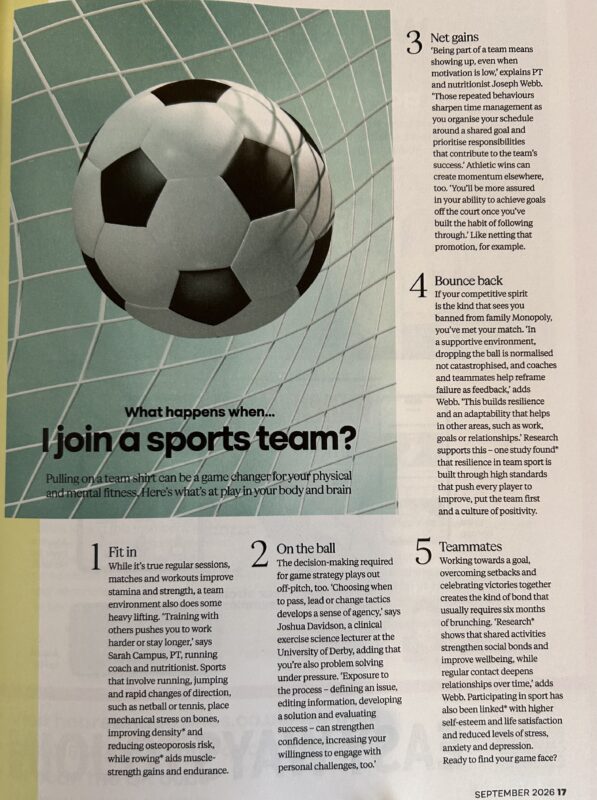
I contributed to the September 2026 print edition of Women’s Health for a feature exploring what happens when you join a sports team – not just physically, but psychologically and socially too.
The article, “What happens when… you join a sports team?”, looks at some of the ways team sport can influence fitness, decision-making, habits, resilience and relationships.
It’s a subject I have a particularly personal connection with.
Before much of my career became focused on coaching, I spent years playing competitive ice hockey. Being part of a team environment from a young age taught me things that went well beyond fitness, and many of the points I discussed with Women’s Health are things I’ve experienced myself.
Showing up when motivation isn’t there
One of the realities of playing a team sport is that you can’t always base your actions on how motivated you happen to feel that day.
There are training sessions to attend, games to prepare for and teammates relying on you.
That repeated process of showing up can help develop habits that carry over elsewhere.
As I explained to Women’s Health:
“Those repeated behaviours sharpen time management as you organise your schedule around a shared goal and prioritise responsibilities that contribute to the team’s success.”
I recognise that from my own playing days.
Training and competing had to fit around everything else going on in life. You learned to organise your time because training wasn’t something you simply did when you felt like it.
And when you’re training with a team, there’s a different kind of accountability.
You’re not only turning up for yourself. Other people are expecting you to be there and everyone is working towards the same objective.
Over time, repeatedly committing to something and following through can give you greater confidence in your ability to do the same elsewhere in life.
Sport teaches you how to lose
Competitive sport also means getting things wrong.
You lose games.
You make mistakes.
You miss opportunities.
Sometimes you train hard all week and still don’t perform particularly well when it matters.
I experienced plenty of that during my playing days, and looking back, learning how to respond to those moments was probably one of the most valuable things sport gave me.
In a supportive team environment, mistakes can become part of the process rather than something to be frightened of.
As I explained in Women’s Health:
“In a supportive environment, dropping the ball is normalised not catastrophised, and coaches and teammates help reframe failure as feedback.”
The article discusses how this can help develop resilience and adaptability.
That’s something I strongly recognise from competitive sport.
After a bad game, you don’t have the option of dwelling on it forever. There will normally be another training session and another game coming.
You look at what happened, work out what you can improve and go again.
That ability to experience a setback without allowing it to define what happens next can carry over into careers, relationships, health goals and plenty of other areas of life.
You’re working towards something together
The social side of team sport is also very different from simply exercising alongside other people.
When you’re part of a team, you spend a lot of time together.
You train together. Travel together. Win together. Lose together.
You experience pressure together and work towards the same objective.
Some of my strongest memories from my playing days aren’t necessarily individual goals or particular results. They’re the experiences around being part of the team – training, travelling, sitting in changing rooms and sharing all of the highs and lows that come with competitive sport.
That’s another area I discussed with Women’s Health.
Shared activities can help strengthen social bonds and improve wellbeing, while seeing the same people consistently over time gives relationships an opportunity to develop.
There is something powerful about belonging to a group where everyone is working towards the same thing.
For adults in particular, I think that’s worth remembering.
We often talk about exercise purely in terms of calories, cardiovascular fitness, strength or body composition.
But joining a sports team can also give someone a community.
People expect you to turn up.
They notice when you’re not there.
You share experiences with them.
And over months and years, those relationships can become an important part of your life.
More than physical fitness
Having experienced competitive team sport myself and then spending much of my career coaching other people, I’ve come to appreciate that many of the benefits of sport are difficult to capture with physical measurements alone.
Yes, playing sport can make you fitter, stronger and more athletic.
But it can also teach you to organise your time.
To turn up when motivation is low.
To communicate with different personalities.
To handle pressure.
To lose.
To make mistakes.
To support other people when things aren’t going well.
And to come back and try again.
Those lessons have stayed with me long after my competitive playing days ended.
It’s one of the reasons this was such an interesting Women’s Health feature for me to contribute to. I wasn’t looking at the subject purely through the eyes of a personal trainer. A lot of what I was discussing were behaviours and experiences I’d lived through myself as part of a team.
My contribution appears in the September 2026 print edition of Women’s Health.
Joseph Webb
Expert coaching. Entirely personal.
Chartered Personal Trainer | FRSPH | FCIMSPA
