
A mile is long enough to tell you something useful about your aerobic fitness, but short enough to be a practical benchmark for most recreational runners.
For this Metro feature, I was asked how mile times tend to change as we get older, what broad ranges might be realistic at different stages of life and how training priorities should change with age. My comments were substantial enough that the story was subsequently picked up elsewhere too.
Ages 20–39: building speed and endurance
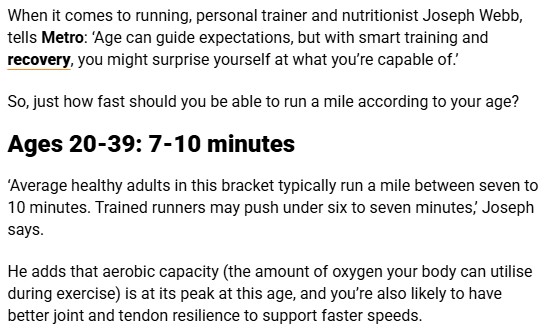
For healthy adults in their 20s and 30s, I gave a broad reference range of around 7 to 10 minutes for a mile.
This is generally the period when aerobic capacity, recovery and tolerance for higher training loads are at their strongest. Joints and tendons will also often cope better with faster running and greater volumes than they may later in life.
That doesn’t mean everyone in this age bracket should be chasing a seven-minute mile.
Training history matters enormously. Someone starting to run at 35 has a very different baseline from someone who has trained consistently since their teens.
For people who do want to improve, I would usually combine easier endurance work with some faster running rather than making every session hard.
Ages 40–59: quality becomes increasingly important
For runners in their 40s and 50s, the broad range I discussed was around 9 to 12 minutes.
Ageing does bring gradual changes in aerobic capacity, muscle mass and recovery, but those changes are heavily influenced by how active someone remains.
A well-trained runner in their 50s may comfortably outperform someone much younger who does little exercise.
This is also where strength training becomes increasingly valuable.
Maintaining muscle, keeping the lower body strong and managing training load properly can help support running performance while reducing the temptation to simply accumulate more and more mileage.
For many people in this age group, two to four well-planned runs each week can be more productive than trying to run every day.
Ages 60+: capability matters more than chasing mileage
For adults over 60, I suggested a broad mile range of approximately 11 to 15 minutes, while making the important point that these are only general guides.
There are plenty of runners in their 60s and beyond who are considerably faster.
The bigger shift for me is in what we prioritise.
As I explained:
“Maintaining aerobic fitness, balance, and joint mobility is the priority, not accumulating big mileage.”
That captures the way I think about running later in life.
Running can remain part of the programme, but it should sit alongside strength work, balance training, mobility and appropriate recovery.
Your age is only part of the picture
One of the problems with articles about “how fast you should be” is that the number can easily become more important than the context.
Mile performance is affected by much more than age.
Training history, genetics, body size, injury history, current fitness, sleep, terrain and even weather can all influence the time someone runs.
So I wouldn’t use these ranges as a pass-or-fail test.
A much more useful comparison is often with yourself.
If you ran a mile in 12 minutes a few months ago and can now complete it comfortably in 11:30, that tells us something meaningful about your progress.
Running frequency should change with the person
For younger runners with an established training background, three to five runs per week may be perfectly manageable.
As recovery needs increase with age, two to four quality sessions may be more appropriate through middle age, with many runners over 60 doing very well on two or three runs alongside other forms of training.
There is no prize for doing more running than your body can recover from.
The right amount is the amount that allows you to train consistently, improve where appropriate and remain healthy enough to keep doing it.
The mile as a benchmark, not a judgement
I like the mile because it gives people something simple to measure.
You don’t need specialist equipment or a complicated testing protocol.
But the number itself shouldn’t define whether you’re “fit”.
Use it as information.
See where you are.
Train appropriately.
And if your goal is to improve it, focus on gradual progress rather than comparing yourself with somebody else’s stopwatch.
Joseph Webb
Expert coaching. Entirely personal.
Chartered Personal Trainer | FRSPH | FCIMSPA
