

If you’re trying to get back into exercise, there’s a very easy trap to fall into.
You look at someone who is already in good shape and ask what they’re doing.
Perhaps it’s a friend who’s suddenly looking and feeling fantastic and tells you they’ve started Pilates.
Maybe it’s someone you follow online who swears by strength training.
Or you see someone getting great results from running, HIIT, CrossFit or something else entirely.
and you think: Maybe that’s what I need to do.
And sometimes it is.
Seeing somebody else succeed can give us the push we need to get started.
But there’s a problem with building your exercise routine entirely around what worked for somebody else.
You’re not them.
The best exercise for somebody else might be completely wrong for you
I’ve worked as a personal trainer for more than 20 years, and one thing I’ve seen repeatedly is people starting with the exercise they think they should be doing rather than asking what might actually work for them.
They haven’t exercised properly for two years, but decide they need to start doing intense HIIT workouts five times a week.
They go back to running because that’s how they got fit ten years ago, despite their knee now giving them trouble.
Or they join a gym because that’s what getting fit is supposed to look like, despite knowing deep down that they’ve never particularly enjoyed gyms.
A couple of weeks later they’re extremely sore, something hurts, life gets busy or they simply realise they’re not enjoying themselves.
Exercise stops.
Then comes the frustrating bit: Why can everybody else stick to this and I can’t?
I don’t think that’s always a motivation problem.
Sometimes you’ve simply chosen the wrong starting point.
If you have an injury or persistent pain, that may also mean getting appropriate medical or physiotherapy advice before deciding what exercise is suitable. Starting sensibly isn’t the same thing as avoiding challenge.
Start by asking a completely different question
If somebody comes to me wanting to get back in shape, I’m interested in their goals. Of course I am.
But there’s another question I think we should ask:
How do you actually enjoy moving your body?
Forget calories for a moment. Forget what your friend is doing. Forget what somebody on Instagram says is the optimal way to train.
What sounds enjoyable?
Maybe you like racket sports. Try padel or tennis.
Maybe you like solving problems and learning skills. Try climbing.
Maybe being outside clears your head. Walking, hiking or cycling might be a much better starting point.
Perhaps you enjoy the feeling of becoming stronger. Strength training could be perfect.
Maybe you like Pilates, swimming, dancing, football or exercising at home where nobody is watching you.
There isn’t a clever answer you’re supposed to give.
The point is to find what interests you most.
Enjoyment isn’t just a nice idea
There is some interesting research behind this.
Researchers studying exercise motivation often distinguish between motivation driven predominantly by outside pressures or outcomes and more autonomous forms of motivation, where we personally value or enjoy what we’re doing.
A large systematic review found that these more autonomous forms of motivation were positively associated with exercise.
Interestingly, intrinsic motivation, aka doing something because of the inherent satisfaction or enjoyment of it, appeared particularly important for longer-term exercise participation.
More recent research continues to support the importance of autonomous motivation, alongside feeling capable and competent at what you’re doing.
That doesn’t mean you’ll love every minute of every workout. I certainly don’t.
And it doesn’t mean results don’t matter.
It means enjoyment deserves a much bigger place in the conversation about getting fit than it sometimes gets.
Make exercise compete with the life you already have
This is something I’ve thought about a lot.
For a change to become a genuine lifestyle, in some way the new life needs to become more attractive than the one you’re asking yourself to leave behind.
Imagine you’ve worked all day. You’re tired. It’s Monday evening.
Your current routine is sitting on the sofa, ordering a Deliveroo and watching the TV.
You might not particularly like what that routine is doing to your fitness or waistline, but let’s be fair: sitting on the sofa after a difficult day can be quite enjoyable.
Now compare that with telling yourself:
I need to do a HIIT workout in my living room because I need to lose weight.
You’re asking something you don’t particularly want to do to compete against something comfortable and immediately rewarding.
That’s a difficult battle to keep winning.
But what if Monday became climbing night?
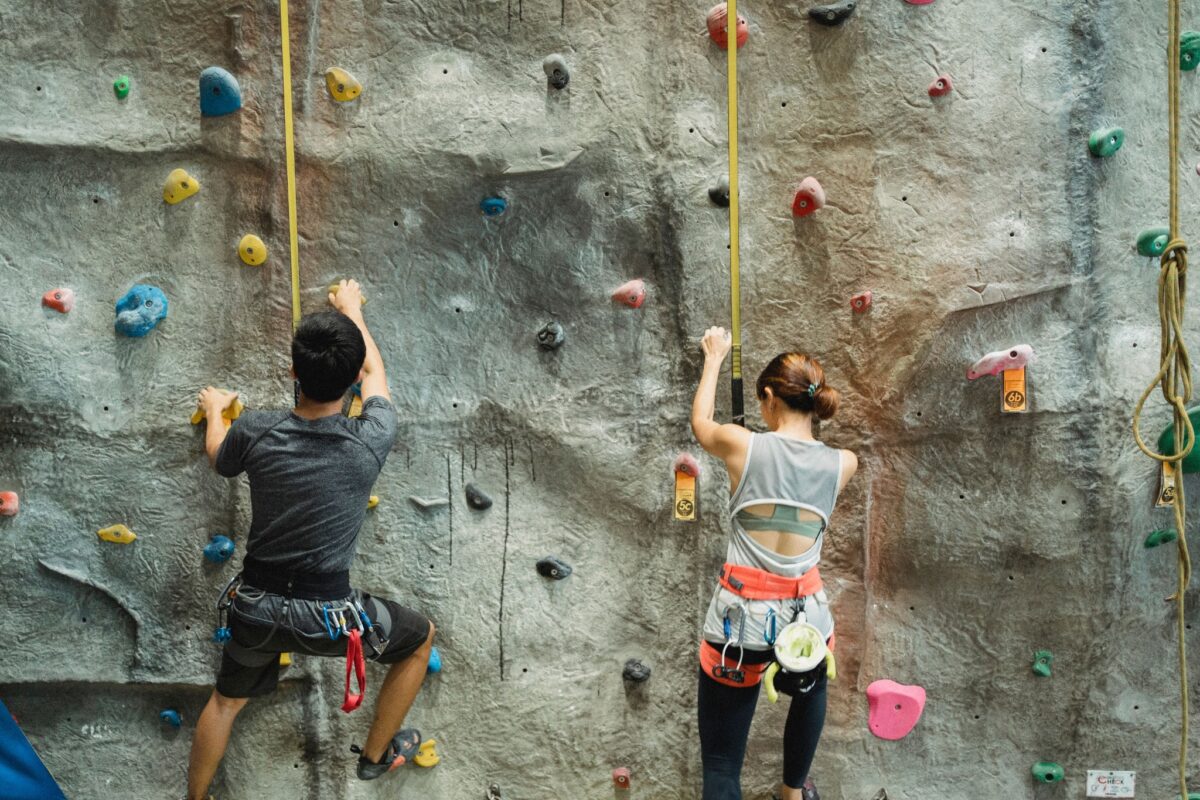
You’ve always fancied climbing. You go to your local climbing wall. You learn something. You meet people. You’re physically active. You’re using your strength and your brain. And every week there’s another route you want to complete.
You’re no longer exercising simply because you’re unhappy with your body.
You’re doing something you look forward to.
Then something interesting can happen.
Perhaps you start thinking, I’d find that climb easier if I were a little stronger.
So strength training suddenly has a purpose.
Perhaps carrying less excess weight would make climbing easier, so improving your diet starts to matter for something beyond what you see in the mirror.
Fitness becomes useful.
Instead of exercise being the punishment required to get the body you want, getting fitter starts helping you do more of something you already enjoy.
That’s a very different relationship with exercise.
I’ve seen this with clients
I train a client who plays football on Tuesdays and Thursdays.
He absolutely loves it.
He talks about football. He looks forward to playing. When he’s on the pitch he’s not standing there thinking about improving his cardiovascular fitness.
He’s playing a game.
But of course he’s also running, changing direction, working hard and improving his fitness.
There’s a social side to it too. For that period of time, he doesn’t have to be Dad, husband or colleague. He’s playing football with other people and having fun.
I think adults sometimes underestimate how important that is.
Exercise doesn’t always need to look like exercise.
What if the thing you love isn’t practical?
This is where we have to be realistic.
Maybe you’d love to spend two hours hiking three times a week, but you have young children and a demanding job.
Perhaps climbing sounds brilliant, but the nearest wall is 45 minutes away.
That’s fine.
Don’t look for perfect. Look for the most enjoyable option that’s realistic in your life right now.
One exercise I sometimes suggest is writing down five ways you genuinely like, or think you might like, to be active.
Then look at each one honestly.
How much time does it require?
What does it cost?
How far do you need to travel?
Could you realistically do it every week?
Does your body currently tolerate it?
You may discover that hiking is your number one choice but isn’t practical every Tuesday evening. Pilates at home might only be number three, but you like it and can actually do it.
Start there.
Follow your interests.
You can build from it.
Don’t start at the level you think you should be at
There’s another common mistake when returning to exercise: doing far too much, far too soon.
People remember what they used to be capable of, or compare themselves with people who have been training consistently for years.
They attack the first few workouts.
Then they’re sore for four days.
That’s not necessary.
One of my jobs as a personal trainer is actually to hold people back when appropriate. If somebody hasn’t exercised for years, I don’t need to prove how hard I can make them work.
We need to find their starting point.
We can strengthen what needs strengthening, work around appropriate limitations, gradually improve fitness and let their confidence grow alongside their ability.
Challenge can come later.
Progression can come later.
First, I want exercise to become something that has a place in their life.
You don’t need to find the perfect exercise
Ultimately, different forms of physical activity provide different benefits.
UK physical activity guidance recommends a combination of cardiovascular activity and muscle-strengthening work, and over time I’d generally want someone’s lifestyle to contain a good mixture of movement.
But you don’t have to create the perfect fitness programme on day one.
If you’ve spent years starting and stopping, I’d rather see you begin with something you genuinely want to do and build from there.
So if you’re thinking about getting back into exercise, try asking yourself these questions:
What physical activities have I enjoyed in the past?
What have I always wanted to try?
What could I realistically do in my life at the moment?
And perhaps most importantly:
What could I actually look forward to doing next week?
Start there.
You can worry about optimising everything later.
Because the programme that looks perfect on paper isn’t much use if you don’t want to do it.
Getting back into exercise with the right support
A large part of my work is helping people who want to exercise again but haven’t yet found a way to make it stick.
Sometimes that means private strength and fitness sessions with me.
Sometimes my role is helping somebody build enough strength, fitness and confidence to get back to the activities they really want to do. Often it’s a combination of the two.
I provide private personal training in clients’ homes across Henley-on-Thames and the surrounding areas of Oxfordshire, Berkshire and Buckinghamshire, as well as online coaching for people further afield.
If you’re ready to get back into exercise but don’t want another short-lived attempt at getting fit, get in touch and tell me a little about where you are now and what you’d actually like to be able to do.
Speak soon,
Joseph Webb
Expert coaching. Entirely personal.
Chartered Personal Trainer | FRSPH | FCIMSPA
