

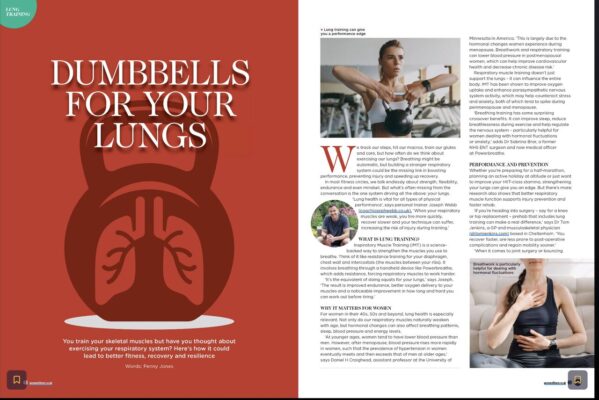
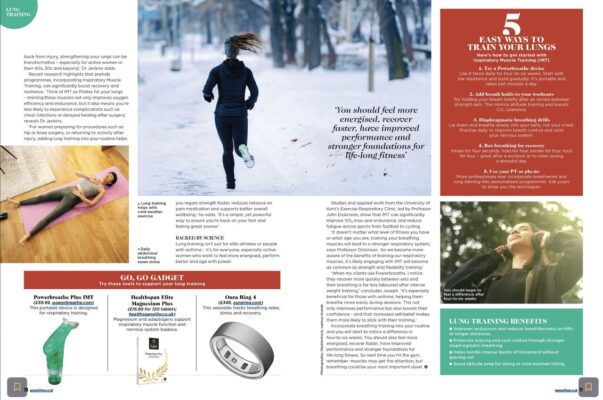
I was pleased to contribute to Women’s Fitness magazine with a feature looking at an area of performance training that is often overlooked – the muscles we use to breathe.
The feature appeared in both the print edition of Women’s Fitness and online, where I explored how inspiratory muscle training (IMT) could potentially improve endurance, exercise performance and recovery.
When exercise intensity increases, our breathing muscles have to work considerably harder. At rest, we might breathe around 12 times per minute, but during intense exercise this can increase dramatically.
Just like other muscles, the muscles responsible for breathing can fatigue.
This becomes particularly interesting for athletes because when the inspiratory muscles become fatigued, the body can respond by redirecting blood flow towards them and away from the working limbs – a response known as the metaboreflex.
This is where inspiratory muscle training comes in.
Devices such as POWERbreathe provide resistance as you inhale, effectively allowing you to progressively train the muscles involved in breathing in much the same way that resistance training challenges other muscles.
In the Women’s Fitness feature, I looked at research into how this type of training could influence performance across several sports.
For cyclists, research has shown improvements in time-trial performance following inspiratory muscle training.
For runners, strengthening the inspiratory muscles may help improve performance while reducing some of the competition for blood flow between the breathing muscles and working limbs.
Swimming presents another interesting challenge because body position and the demands of controlling breathing can place significant stress on the respiratory muscles.
I also discussed the potential role of breathing muscle training in recovery, with research suggesting that breathing against a light inspiratory resistance following exercise could potentially help with lactate clearance.
What makes IMT particularly interesting is how little time it can take. It’s a specific form of training that can be performed at home and incorporated alongside an existing strength and conditioning programme.
It certainly shouldn’t replace the fundamentals of good training, but for athletes looking for marginal improvements in endurance and performance, the respiratory muscles are another area worth considering.
It was great to contribute to Women’s Fitness on the subject and to see the feature appear both in the magazine and online.
You can read the online Women’s Fitness feature and my contribution HERE.
