
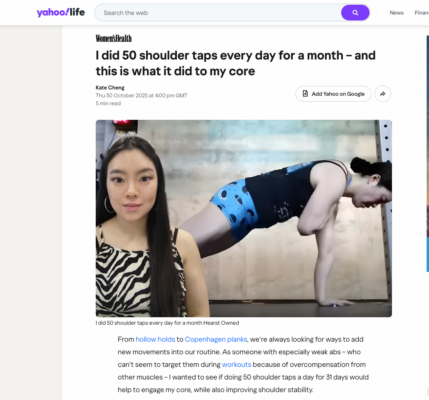
My expert commentary for Women’s Health has also been syndicated by Yahoo Life in a feature exploring what happened when writer Kate Cheng performed 50 shoulder taps every day for a month.
The original Women’s Health experiment looked at whether consistently performing shoulder taps could improve core strength, stability and upper-body control.
For the article, I explained that shoulder taps can essentially be thought of as a moving plank.

Each time you lift one hand from the floor to tap the opposite shoulder, your body naturally wants to rotate. Your core has to work to resist that movement while your shoulders, chest, glutes and other stabilising muscles help you maintain a strong position.
That makes the exercise particularly useful for developing what we call anti-rotation – the ability of the trunk to resist unwanted rotational movement.
Technique is important, though.
Rather than trying to complete the repetitions as quickly as possible, the aim should be to keep the hips relatively still and maintain control throughout each repetition. If the body is excessively rocking from side to side, much of the challenge we’re looking for is being lost.
The article also looked at how shoulder taps compare with push-ups.
I wouldn’t consider one exercise better than the other because they have different purposes. Push-ups are primarily an upper-body strength exercise, whereas shoulder taps introduce a greater challenge to stability, balance and control through the trunk.
Depending on someone’s goals, both can have a place within a strength programme.
It’s great to see the original Women’s Health feature reach an even wider audience through Yahoo Life, following its syndication across other major online publications.
You can read the Yahoo Life version and my expert contribution HERE.
