
I contributed to The i Paper for a feature looking at the daily habits busy people use to stay fit and healthy without needing perfect routines or huge amounts of spare time.
The article brought together practical advice from a range of fitness experts, covering everything from walking and mobility to micro-workouts, meal prep and recovery.
My contribution focused on something I think matters more than most people realise:
enjoyment.
The people who stick with fitness usually enjoy something about it
After more than 20 years of coaching, one pattern has become very clear to me.
The people who stay consistent over the long term are rarely the ones forcing themselves through a form of exercise they dislike indefinitely.
They tend to enjoy either the training itself or the outcome enough to keep coming back.
As I explained to The i Paper:
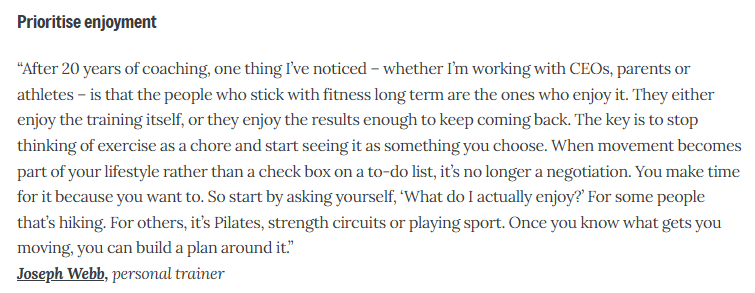
“After 20 years of coaching, one thing I’ve noticed – whether I’m working with CEOs, parents or athletes – is that the people who stick with fitness long term are the ones who enjoy it.”
That has become one of the most important principles behind the way I coach.
Exercise shouldn’t feel like another chore
For busy people, time is already limited.
Work, family, commuting and everything else competing for attention can make exercise very easy to push down the list.
If training also feels like an obligation you dread, consistency becomes even harder.
That is why I think it helps to stop looking at exercise purely as another task that needs completing.
The aim is to find a way of moving that feels valuable enough that you actually want to return to it.
That does not mean every workout needs to be fun.
Some sessions will be hard.
Some days motivation will be low.
But there should be enough enjoyment, satisfaction or personal meaning in the process to make continuing worthwhile.
Find the form of movement that works for you
This is where fitness becomes very individual.
For one person, the answer might be strength training.
Someone else may prefer hiking, Pilates, running or playing sport.
There is no prize for choosing the form of exercise someone else thinks you should enjoy.
The useful question is:
What do you actually like doing enough to keep doing?
Once you know that, you can build a sensible training plan around it.
That is usually a much stronger foundation than choosing a programme purely because it is fashionable or supposedly optimal.
Consistency beats the perfect plan
This is particularly important for busy people.
You do not necessarily need the most sophisticated training programme.
You need something that fits your life well enough to be repeated.
A theoretically perfect routine that gets abandoned after three weeks is less useful than a good routine that becomes part of your life for years.
That is why I told The i Paper:
“When movement becomes part of your lifestyle rather than a check box on a to-do list, it’s no longer a negotiation.”
That is the point where exercise becomes much easier to sustain.
Start with enjoyment, then build structure
Enjoyment does not mean training without direction.
Once you identify the activities you genuinely like, you can still add structure.
You can gradually increase strength.
Improve cardiovascular fitness.
Work on mobility.
Set goals.
Track progress.
But you are building all of that around something you already have a reason to keep doing.
That is a far more sustainable approach than repeatedly trying to force yourself into somebody else’s idea of fitness.
Helping people make exercise stick
This feature captures something I have increasingly come to believe over the course of my career.
Most people do not need another complicated fitness rule.
They need help finding an approach that fits their life and gives them enough reason to continue.
For some people, that means returning to something they used to enjoy.
For others, it means trying different forms of exercise until something clicks.
The individual should come before the programme.
Because ultimately, the best form of exercise is one that improves your health and that you can see yourself continuing to do.
You can read the full article HERE and my contribution in The i Paper.
Joseph Webb
Expert coaching. Entirely personal.
Chartered Personal Trainer | FRSPH | FCIMSPA
