
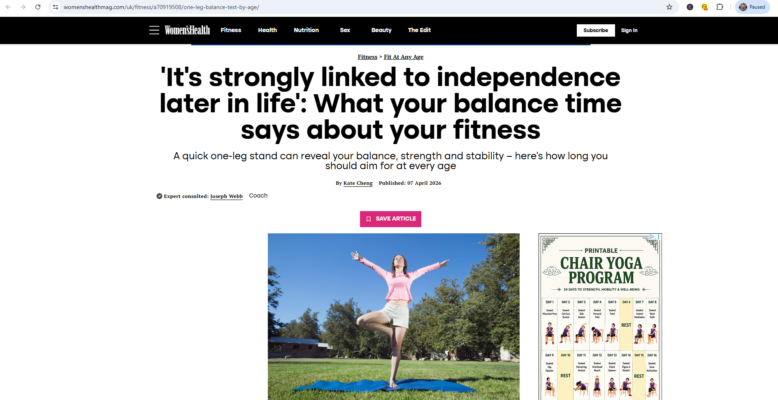
How long can you comfortably stand on one leg?
It sounds like a very simple test, but balance brings together strength, coordination, joint stability and the nervous system. I contributed to Women’s Health for a feature looking at what a one-leg stand can tell us about our physical function, how ability tends to change with age and, importantly, how we can improve it.
Why balance matters
Balance is easy to overlook when we’re younger.
We tend to think much more about strength, cardiovascular fitness or how much weight we can lift. But the ability to control our body becomes increasingly important as we get older.
As I explained to Women’s Health:
“It’s strongly linked to lower injury risk, better mobility and staying independent later in life.”
A one-leg stand shouldn’t be treated as a definitive test of someone’s overall fitness, but it can provide a useful snapshot.
If you find balancing on one side particularly difficult, it may highlight an area worth working on, whether that’s strength, coordination, ankle stability or simply familiarity with balancing.
How long should you be able to balance?
For the article, I provided approximate reference points across different age groups:
- 20–29: 50–60+ seconds
- 30–39: 45–55+ seconds
- 40–49: 40–50+ seconds
- 50–59: 30–40+ seconds
- 60–69: 20–30+ seconds
- 70–79: 10–20+ seconds
- 80–89: 5–10+ seconds
These aren’t pass-or-fail numbers.
There is plenty of individual variation and no reason someone can’t perform considerably better than the suggested range for their age.
The more useful question is often whether your balance is improving.
More muscles are working than you might think
Standing on one leg might look passive, but several areas are constantly making small adjustments to keep you upright.
Your glutes and muscles around the hip help stabilise the pelvis.
Your core helps control your trunk.
The muscles around the ankle and lower leg make continuous corrections, while the smaller muscles of the foot help you respond to changes in pressure beneath you.
All of that has to happen together.
That’s one reason balance can be such an interesting measure of physical capability.
How to perform the test
The basic test is very straightforward.
Stand tall and lift one foot from the floor.
Keep a slight bend in the standing knee rather than locking it completely.
Fix your eyes on something in front of you and think about maintaining a firm foot, active glute and tall torso.
Then time how long you can maintain the position with control.
If necessary, practise close to a wall or another stable surface so you have something available to hold if you lose your balance.
Balance is trainable
One of the encouraging things about balance is that regular practice can make a noticeable difference.
You don’t need a complicated programme.
Something as simple as practising your one-leg stand regularly can help.
I often suggest using an existing daily habit as a reminder.
Brushing your teeth is an easy example. If you’re brushing for two minutes, you could spend roughly one minute balancing on each leg.
As your balance improves, you can make the exercise more challenging by slowly moving the free leg forwards, backwards or out to the side.
You could even try tracing letters of the alphabet with the free foot while maintaining your position.
Don’t forget the feet and hips
Where appropriate, practising barefoot can also be useful because it allows the foot and ankle to contribute naturally to maintaining your position.
At the same time, don’t forget what is happening higher up the chain.
Engaging the glute on the standing side can help stabilise the hip and make the whole position feel considerably more controlled.
As with most things in training, the goal isn’t simply to survive for as long as possible.
It’s to maintain a good position and gradually improve your control.
A small test with a useful message
I like the one-leg stand because it’s simple.
You don’t need a gym, specialist equipment or much time.
More importantly, it shifts some attention towards qualities that become increasingly valuable as we age.
Strength matters.
Cardiovascular fitness matters.
But so does being able to control your body, move confidently and maintain your independence.
Balance deserves a place in that conversation too.
You can read my full contribution in Women’s Health HERE.
Joseph Webb.
