
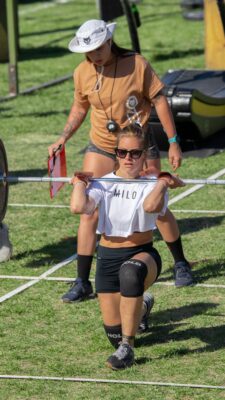
I contributed to Women’s Health for a feature looking at a simple way to change an arm workout without immediately reaching for heavier weights: performing exercises from a tall-kneeling position.
Moving from standing to kneeling changes the way the body can assist the exercise.
When you’re standing, it’s relatively easy to generate momentum by bending the knees, driving through the hips or leaning backwards as a set becomes difficult.
Tall kneeling removes much of that opportunity.
That can make the exercise feel more demanding, even when the weight itself hasn’t changed.
Less momentum, more control
One of the main benefits of the position is that it encourages more deliberate repetitions.
As I explained in the article:
“By taking much of your lower body out of the exercise, you reduce some of the opportunities to generate momentum and are encouraged to pay closer attention to your posture, core engagement and the quality of each rep.”
That doesn’t make kneeling automatically better than standing.
It simply changes the challenge.
For someone who tends to rush through repetitions or use excessive body movement, tall kneeling can be a useful way to slow things down and improve awareness of what they’re actually doing.
Your core has to contribute
Removing the support and small adjustments normally provided by the feet, ankles and lower legs also changes the stability demands of the exercise.
The abdominal muscles and glutes have to contribute to keeping the pelvis and ribcage controlled while the arms move.
That can make exercises such as curls, presses and raises feel quite different.
The aim isn’t to brace as hard as possible.
I generally encourage people to stay tall, keep the glutes gently engaged and maintain control through the trunk while continuing to breathe normally.
Technique before failure
Another point I discussed with Women’s Health was where a set should finish.
If someone has to dramatically change their posture, lean backwards or use momentum simply to complete another repetition, the exercise is no longer being performed in the same way.
That’s why I often prefer the idea of form failure.
Once you can no longer maintain the position and quality you’re aiming for, the set has effectively done its job.
You don’t necessarily need to keep going until the target muscle is completely incapable of producing another repetition.
Making differences between sides easier to spot
Kneeling can also be useful when performing exercises one arm at a time.
With less assistance from the lower body and fewer opportunities to shift your weight, differences between the left and right sides can become much more obvious.
You may notice that one arm is stronger, one side feels more stable or that your trunk consistently rotates in one direction.
That information can be useful.
It gives you something to work with rather than simply trying to hide the difference by moving more weight.
A useful variation, not a magic trick
I like tall-kneeling exercises because they’re simple.
You don’t need specialist equipment or a completely different programme.
You can take an exercise you’re already familiar with, change your body position and immediately alter the demands.
But I wouldn’t describe the position as inherently superior.
Standing exercises still have plenty of value.
Tall kneeling is simply another tool that can help improve control, body awareness and the quality of each repetition when it suits the person and the exercise.
You can read my full contribution in Women’s Health HERE.
Joseph Webb.
